THE PURPOSE
Build the laboratory before testing agents.
TENSYM investigates how errors spread between AI agents and the potential value of independent temporal neuro-symbolic verification. Its purpose is not to deliver clinical decision support, but to establish an environment where future agent decisions can be compared against synthetic reference facts.
The first concrete result is an entirely fictional cohort, with source documents and a nominal eCRF. AI agents and injected-error scenarios have not yet been evaluated.
01 / SCIENTIFIC FOUNDATIONS
Published references, not real patient records.
The generator draws on selected published aggregate statistics from SPRINT (Systolic Blood Pressure Intervention Trial), a randomized trial involving 9,361 participants. Reported baseline characteristics, including age, sex and blood-pressure measurements, provide reference points for parameterizing synthetic distributions.
These references do not provide access to individual SPRINT records, nor do they amount to reproducing the trial population or treatment outcomes. Visit schedules, selected correlations and simulated trajectories are TENSYM modeling decisions.
Scientific references are listed at the end of the article. ↓
02 / SYNTHETIC GENERATION
Producing coherent longitudinal trajectories.
The generator does more than sample unrelated values. It represents fictional participants, successive visits and interrelated measurements.
- Distributions informed by published aggregate references, with variation between participants.
- A relationship between systolic (SBP) and diastolic (DBP) blood pressure rather than independent sampling.
- Three SBP / DBP / pulse sets per visit, with visit-level summaries displayed in the interface.
- Four fictional visits per participant: D0, D7, D14 and D28.
- Basic coherence controls and reproducible generation.
No treatment effect was imposed to reproduce SPRINT outcomes.
03 / TECHNICAL CHECKS
Testing the generator before relying on its outputs.
Several verification campaigns were conducted. The robustness run reported in the project notes covered 10,000 synthetic cohorts, representing 100,000 simulated participants and 400,000 visits. It examined technical constraints and the consistency of the generation process.
These checks support the generator’s technical coherence and reproducibility. They do not establish the clinical representativeness of the selected ten participants or medical validity of their trajectories.
Technical validation ≠ clinical validation.
04 / DOCUMENTARY ENVIRONMENT
A browsable and documented cohort.
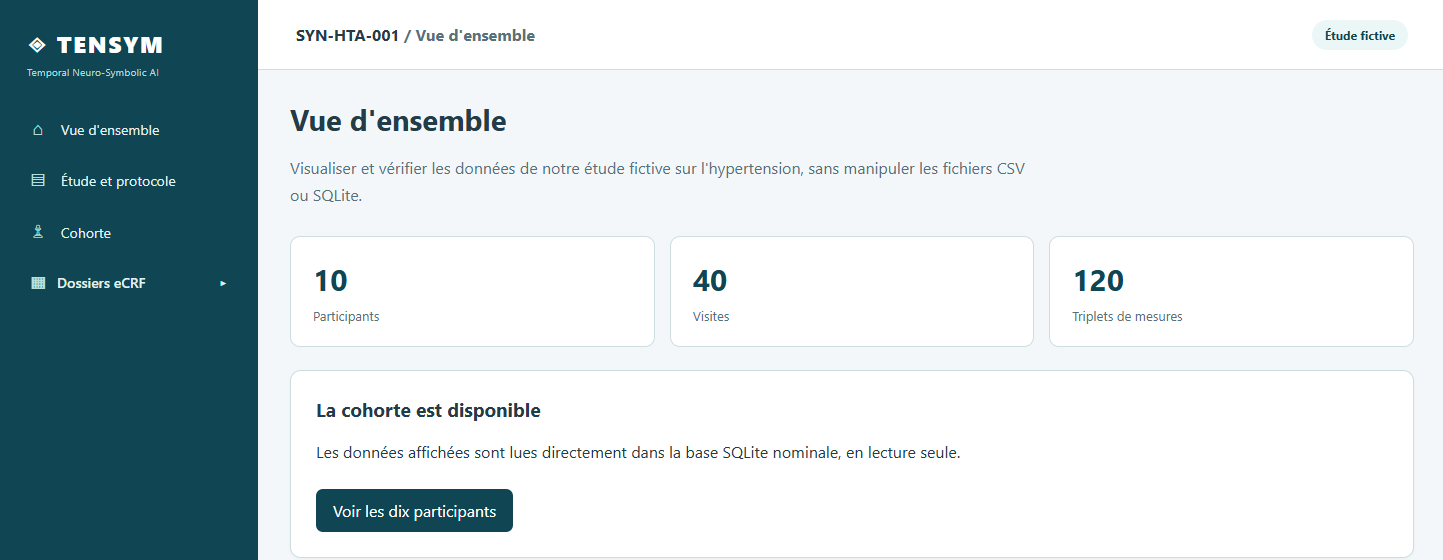
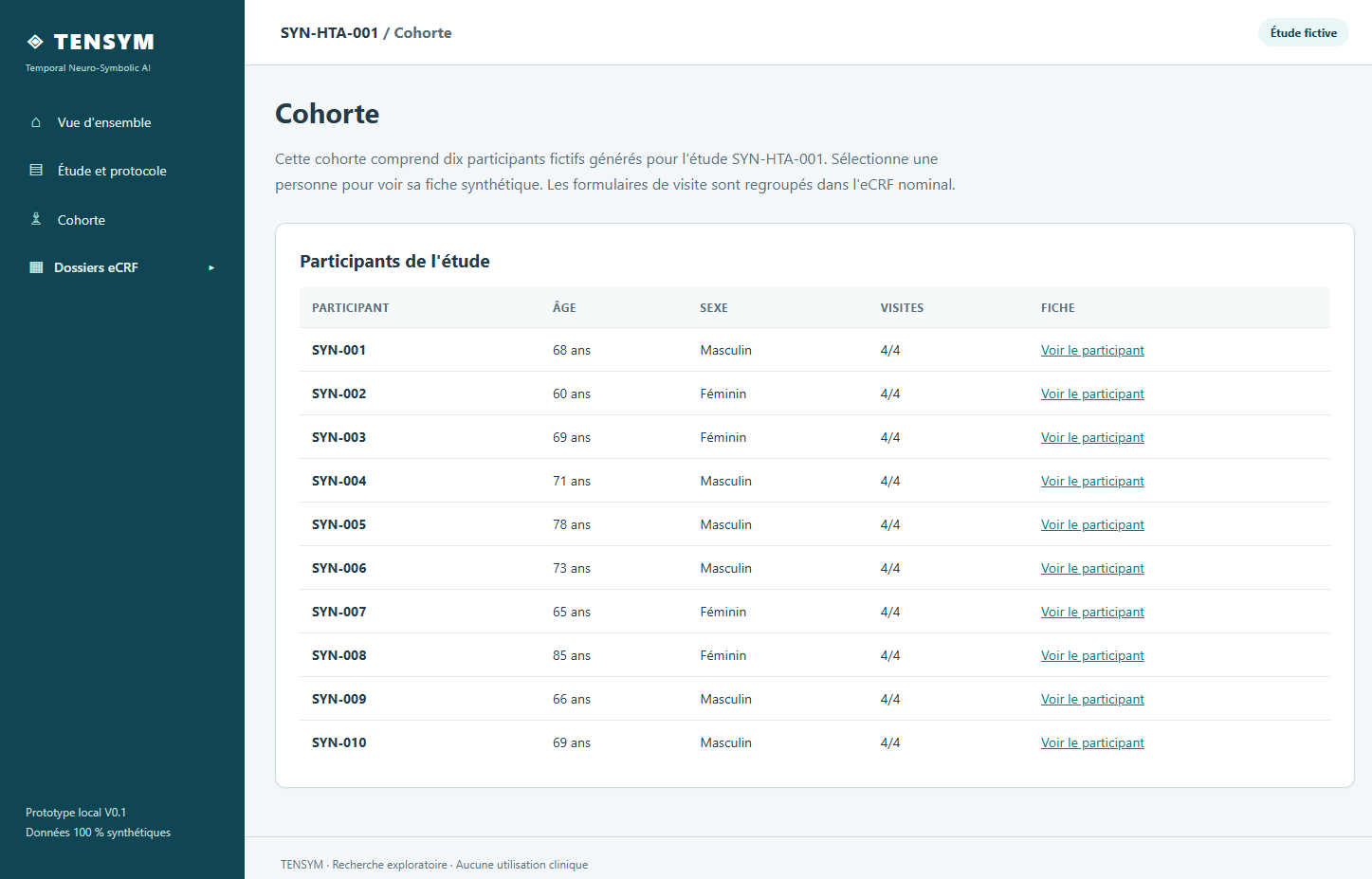
The initial SYN-HTA-001 cohort contains 10 fictional participant IDs, 40 visits, 120 sets of measurements, 40 synthetic source documents and 40 initial nominal eCRF entries. The data are stored in SQLite.
A local web application lets users browse participant records and forms while keeping the nominal data read-only. The screenshots below show the V0.1 prototype; its interface is currently available in French.
05 / TEMPORAL TRAJECTORIES
Observing measurements across visits, not in isolation.
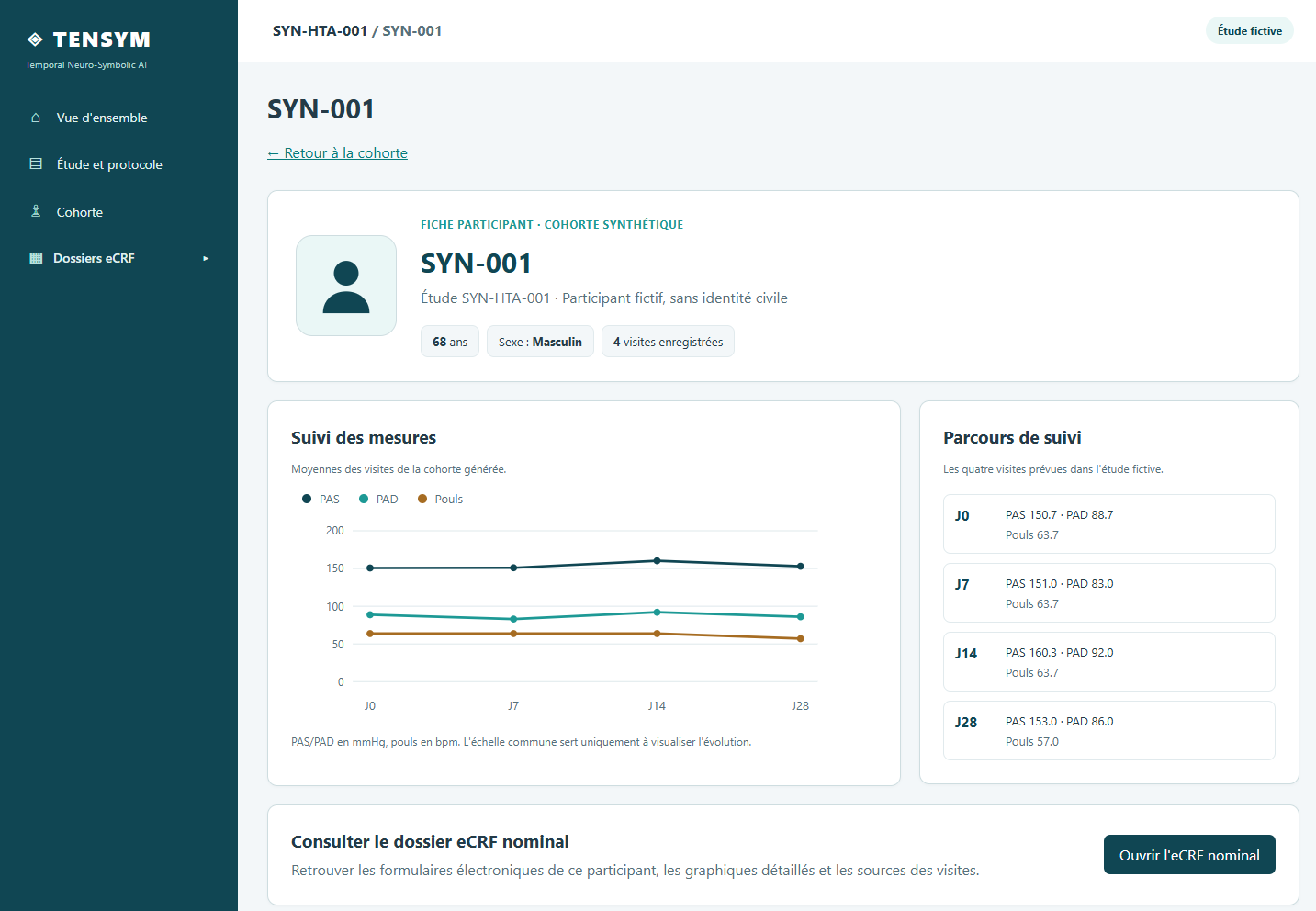
The SYN-001 participant page illustrates longitudinal SBP, DBP and pulse measurements across four visits. These changes are synthetic and serve a documentary and temporal purpose; they are not interpreted as treatment outcomes.
06 / SOURCE DATA, eCRF AND PROVENANCE
Distinguishing an event, its availability and its entry.
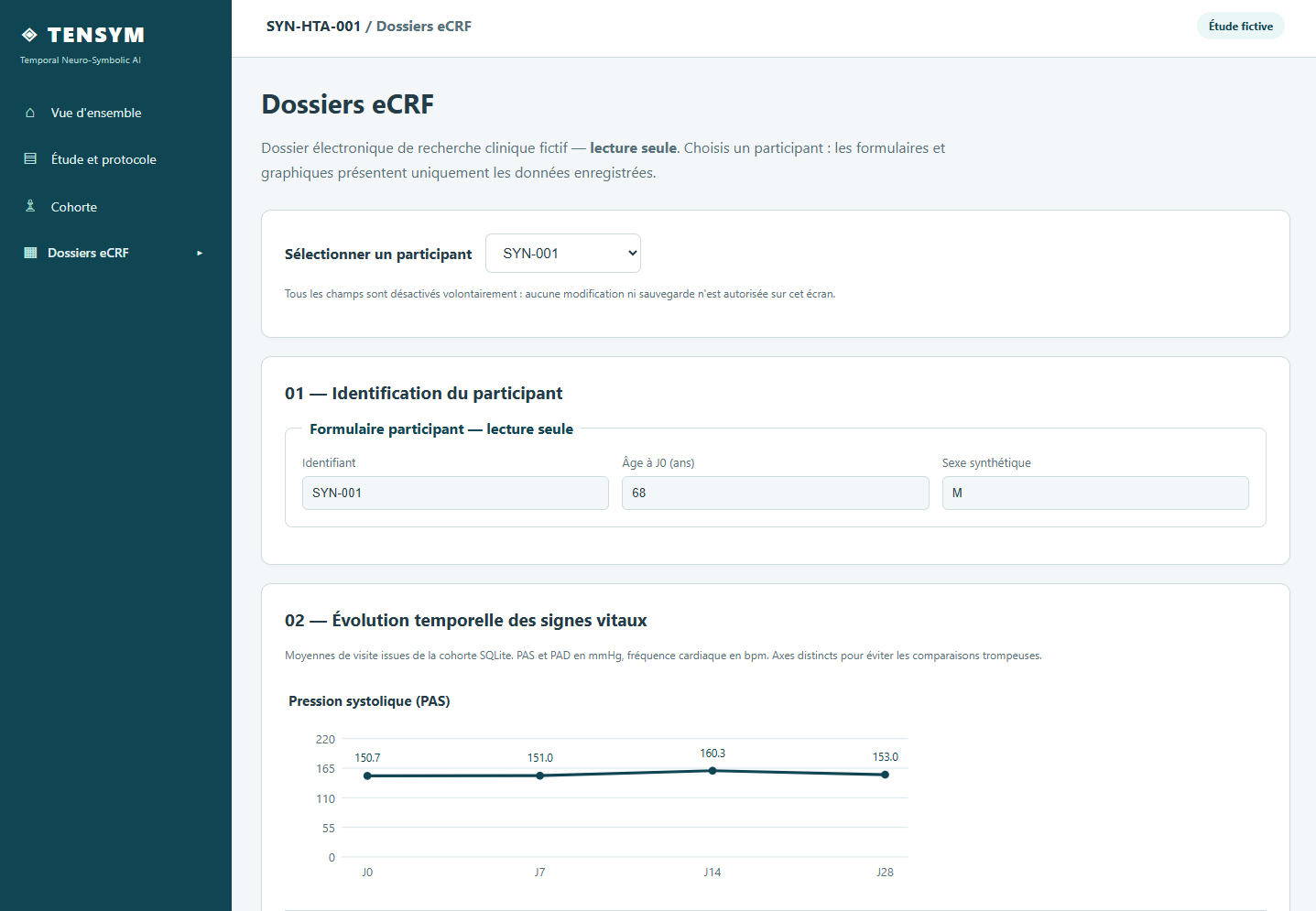
The documentary model distinguishes when a fact was observed, when it became available and when it was entered into the eCRF. This distinction is central to TENSYM’s research question: a decision cannot be justified by evidence that was not yet available at the time.
The current interface presents the nominal eCRF in read-only mode. It is neither a certified eCRF system nor evidence that an active temporal-verification engine has been implemented.
07 / SCOPE AND LIMITATIONS
What this milestone shows — and what it does not.
Completed and documented
- An entirely synthetic participant-data generator.
- Technical coherence and reproducibility tests.
- An initial reproducible cohort structured in SQLite.
- Source documents, nominal eCRF entries and a browsing interface.
Not demonstrated at this stage
- Clinical representativeness of a ten-person synthetic cohort.
- Reduced error propagation between AI agents.
- The effectiveness of an independent temporal rule engine.
- Regulatory compliance or use for medical decisions.
This milestone establishes the setting in which future experiments can be evaluated. It does not predetermine their results.
REFERENCES
Scientific sources.
These publications serve as methodological and statistical references; they do not clinically validate the TENSYM generator.
- SPRINT Research Group (2015). A Randomized Trial of Intensive versus Standard Blood-Pressure Control. New England Journal of Medicine. DOI: 10.1056/NEJMoa1511939 ↗
- Ambrosius et al. (2014). The design and rationale of a multicenter clinical trial comparing two strategies for control of systolic blood pressure. Clinical Trials. DOI: 10.1177/1740774514537404 ↗
- Johnson et al. (2018). Blood Pressure Measurement in the Systolic Blood Pressure Intervention Trial (SPRINT). Full text ↗
TENSYM is an exploratory research project using entirely synthetic data. No real patients, clinical decisions or multi-agent efficacy results are claimed.